
Cities
Plans in the homeland of cable cars
Whether in Zurich, Basel, Geneva, Fribourg, Solothurn, or Lucerne-Kriens: there have been many ideas for urban ropeways in Switzerland, but unfortunately, most projects have failed to progress or have been definitively scrapped.
The biggest hurdle so far has usually been the consent of landowners, as Ueli Stückelberger, Director of the Swiss Public Transport Association (VÖV), pointed out to SI Urban back in 2021: “Landowners block many projects. And even if they agree, there are bound to be neighbors who oppose it.“
Ueli Stückelberger,
Director of the Swiss Public Transport Association (VÖV)
Many Swiss citizens are convinced that a ropeway would disturb their privacy, mar the landscape, and cause noise. Furthermore, the practical sense of such a transport solution is often questioned.
“The pressure of suffering is too low. In Switzerland, compared to other countries, we have enough financial resources to opt for more expensive alternatives, such as a tramway or a road tunnel. We would rather accept higher costs than argue over an urban ropeway,“ says Stückelberger.
Despite this – as of 2026 – there are several ropeway plans that are progressing promisingly. Here is an overview: from rough ideas to advanced projects.
In Biel,
the urban cable car is currently still part of the “Zeropolis” vision.

Vision “Zeropolis“ in Biel
The ropeway project in Biel is still at the vision stage. The system is intended to connect the city center, the lake, and the town, while creating communal spaces. The urban ropeway would have a particularly positive impact on commuters; around 10,000 jobs are located in the target area of the route.
The system would make it easier for residents to commute between the lake, the train station, the center, and the industrial zone. Plans include a 4.9-km city ropeway and a 1.9-km elevated railway over the lake.
The city center would be accessible to everyone within a fifteen-minute travel time. The project team behind “Zeropolis“ aims to gain momentum by 2030 – the horizon by which gondolas should be floating over Biel.
Too early for a rendering
Visionaries are using this retro image to drum up support for a cable car from Liestal to Aesch in the Baselbiet region.

Baselland evaluates ropeways
Traffic jams on the motorway and congested roads: in “Baselbiet“ – the canton surrounding the major Swiss city of Basel – this is a daily reality for commuters.
Gondola lifts integrated into the public transport network are intended to provide relief. As reported by Swiss Radio and Television (SRF), the Cantonal Council passed a proposal by Manuel Ballmer (GLP) with a significant majority at the end of 2025.
Ballmer spoke of a “visionary idea“ that triggered a surprisingly high level of resonance. Possible lines could serve the Pratteln area or even cross the Rhine into Germany.
Linking jobs via transit:
Talks are underway for an aerial cableway over the Rhine to serve the Sisslerfeld industrial area.

High-altitude ropeway
Plans in the neighboring canton of Aargau are significantly more concrete. In the Sisslerfeld industrial area, a high-altitude ropeway crossing the Rhine is being discussed.
With two large stations on either side of the river, the facility could be an ideal solution for developing the roughly 200-hectare industrial zone, of which 85 hectares remain undeveloped.
By 2040, up to 10,000 new jobs could be created there, and the ropeway would offer an efficient and environmentally friendly transport solution. The cantonal parliament (the Grosser Rat of Aargau) has referred a corresponding postulate to the government.
As part of an overall transport concept for the Frick-Stein-Laufenburg region, the government now intends to examine whether a ropeway is indeed a viable solution compared to other measures, such as expanding bus services or adding a new S-Bahn stop.
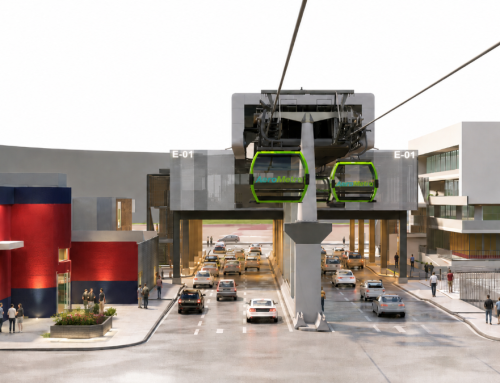
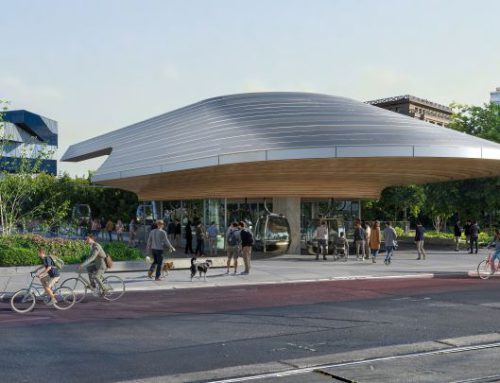
Visualisation of the valley station
The valley station of the zoo cable car at Stettbach SBB station.

Zoo ropeway in the waiting room
And then there is the dream of the Zurich Zoo, which has been a topic of conversation in Switzerland‘s largest city for quite some time: the ropeway. A gondola lift is planned to run from Stettbach station to just outside the main entrance of the zoo on the Zürichberg.
The key data: 2.1 kilometers long, 11 towers, 44 gondolas with 10 seats each, and a 7-minute travel time. In 2025, the Federal Court rejected initial appeals, though others are still pending. For now, the initiators can do nothing but wait for the rulings.
Concept in Lucerne:
Proposed cable car route including a tunnel.

Lucerne makes great strides
The situation looks much better in Lucerne. As already reported, an initiative there is pushing for the construction of an urban ropeway. The concept relies on an innovative combination of above-ground and underground sections and aims primarily to solve the tourist bus problem.
A direct connection between an above-ground parking garage and the city center is planned. According to the concept, the “CityLink“ will serve Lucerne‘s city center, the cantonal hospital, and the Ibach industrial area. It consists of two sections, each approximately one kilometer long.
The centerpiece would be the world‘s longest ropeway tunnel (one kilometer), designed to bypass many time-consuming legal objections. As the portal “Blick“ reported in late 2025, a feasibility study confirms its technical viability.
The project will go to a public vote in November 2026. Implementation is slated for 2033 and is expected to be privately financed at a cost of 150 to 190 million Swiss francs.
In Sion,
an urban cable car is set to connect two districts as early as 2028.

Sion ropeway is being built
In terms of ropeway technology, Sion (Sitten) is the furthest along. The city is realizing an urban ropeway between the districts of Bramois and Nax by 2028. Residents and commuters, as well as tourists, will be transported in just seven minutes.
The ropeway, with a capacity of 50 passengers per cabin, will operate all day and late into the night – compared to the ten or eleven bus trips currently available per day.
The valley station is optimally connected to the Sion city bus network and the regional rail line serving Sion and Sierre. The station in Nax offers connections to Vernamiège, Mase, and St. Martin.

The ropeway is funded by the Confederation, the Canton of Valais, and the municipalities. The project is currently in the coordination phase at the level of the cantonal master plan.
Following this, an operating company will be founded, which will then submit an application for a concession and plan approval to the Federal Office of Transport (FOT). Consequently, the ropeway could go into operation as early as 2028.