Cableway & Technology, Cities, Digitalisation & Innovation, SI-Alpin
How ropeways can harness solar power
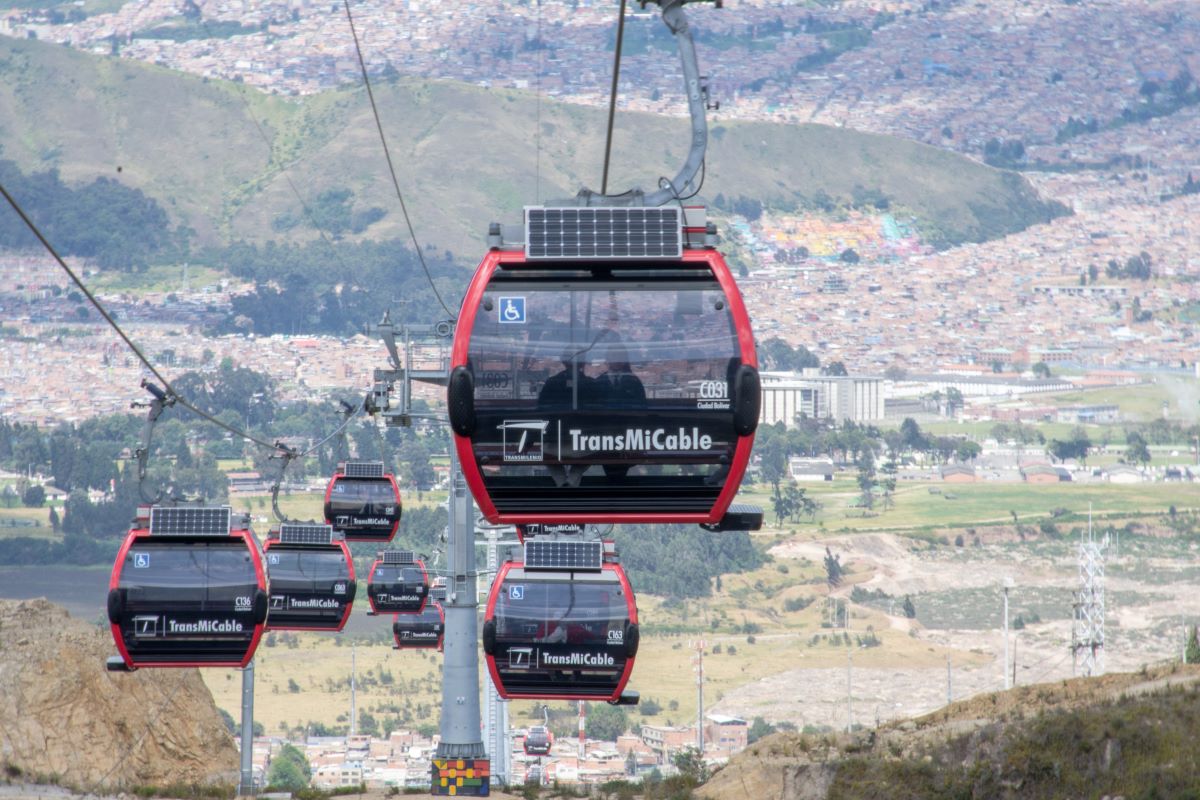
The managing director of the “Mi Teleférico” cable car in the Bolivian city of La Paz, Christian Eduardo, announced that negotiations are currently underway with international organizations to develop a model for self-generation of renewable energy.
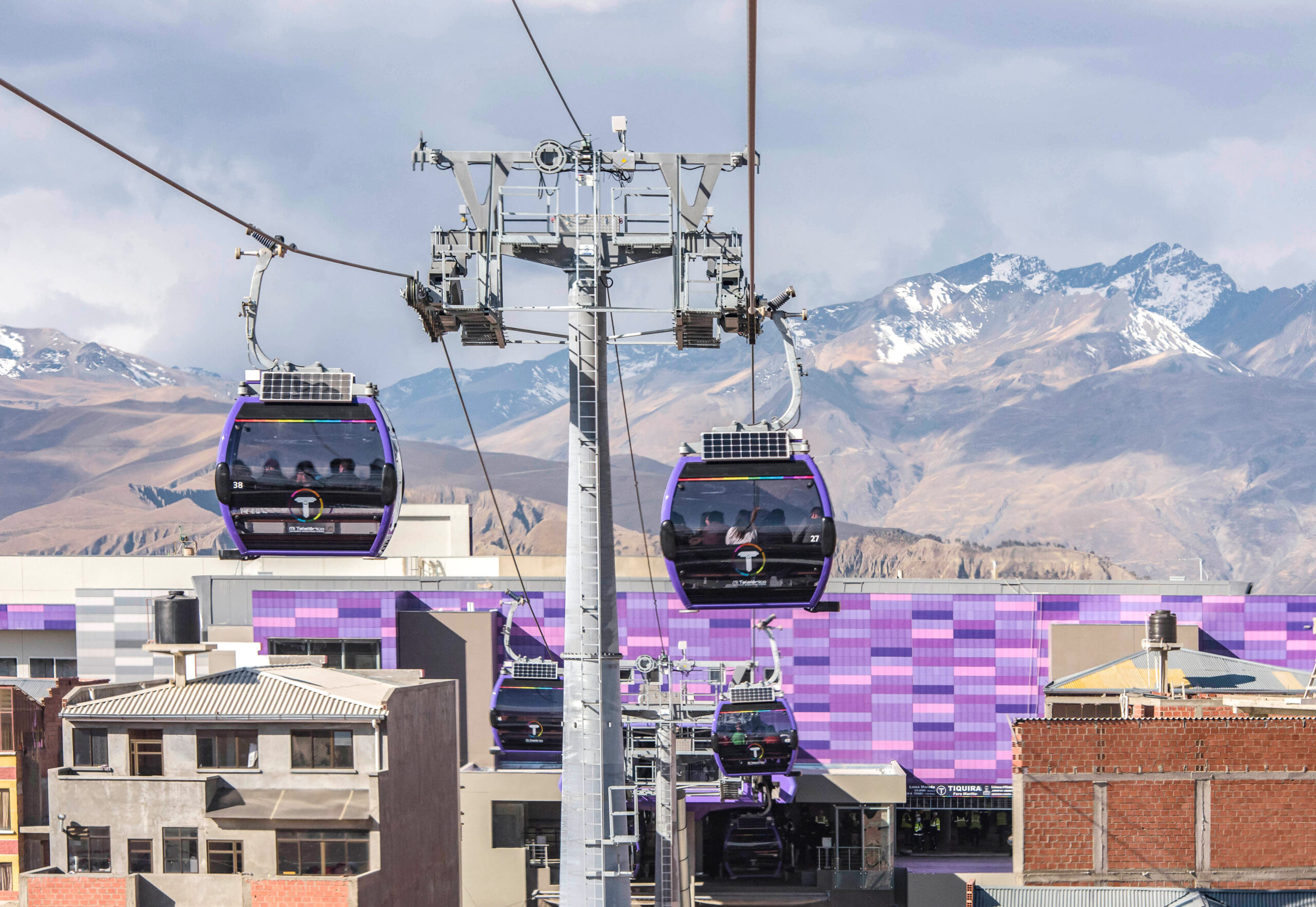
The goal is to reduce dependence on electricity from the public grid through local renewable energy generation. The cabins of “Mi Teleférico” are already equipped with solar panels, which, according to the operator, generate enough energy to power the lighting, intercom systems, and security cameras.
In addition, the installation of photovoltaic systems on the roofs of various stations in the cable car network is planned as part of the implementation of the new line.
Cable car manufacturers emphasize that there are several important points to consider when planning solar and other energy generation projects in cable car operations.
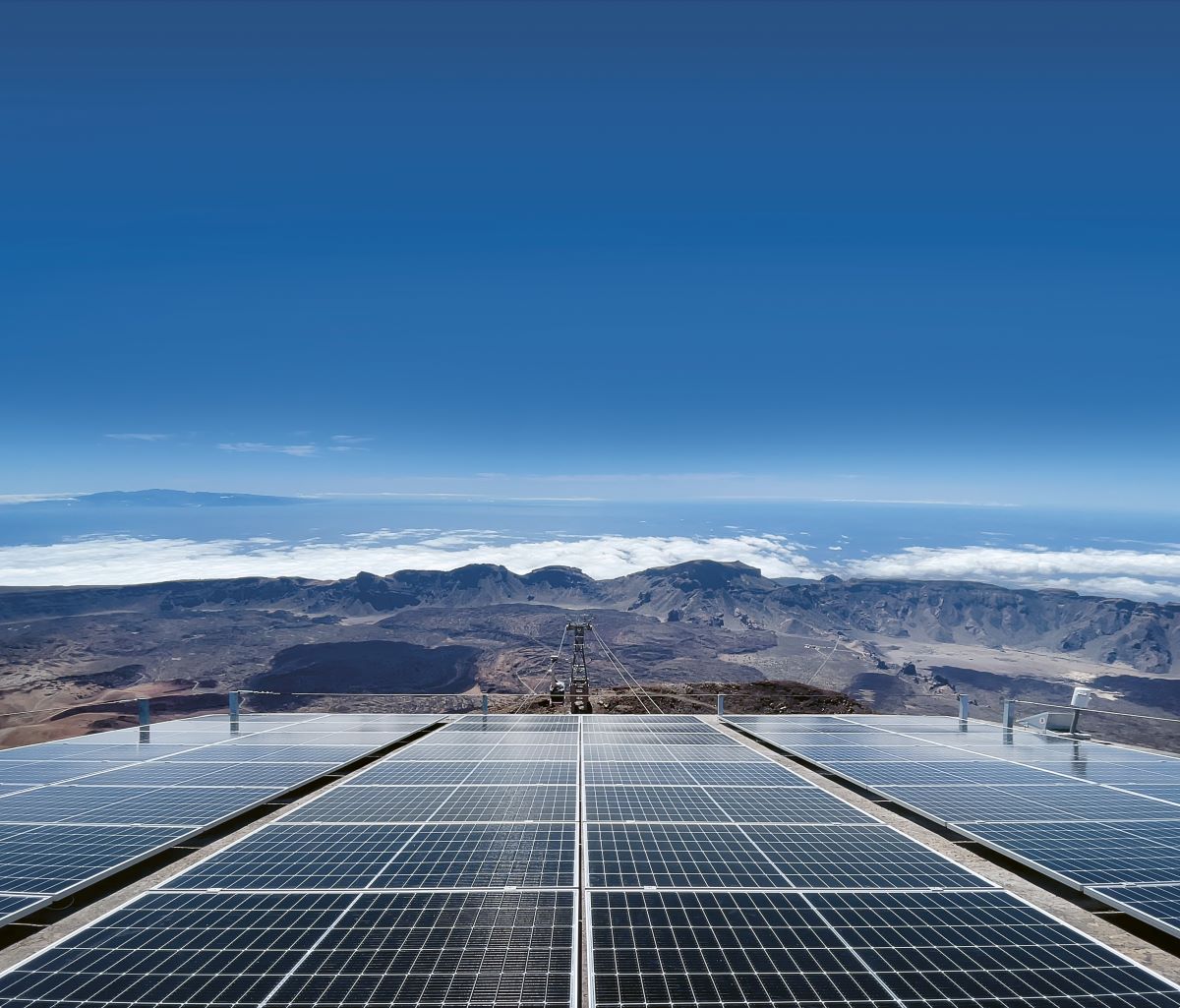
Funicular with storage system:
The Pico del Teide funicular in Spain utilizes a high-performance energy storage system that stores locally generated energy, enabling largely energy-autonomous operation.
Energy saving in focus
Using the sun as an inexhaustible energy source is important and essential for a sustainable future – a point many experts agree on. However, photovoltaic systems do not always produce electricity exactly when it is needed.
The sun does not always shine when energy is required, and during downtime, electricity is generated that cannot be used immediately. This raises the crucial question: how can self-generated energy be stored and used efficiently – and how can overall resource planning be optimized?
“The focus must be on the overall energy balance: that is, the interplay of self-generated electricity, the use of renewable energy, and smart off-take planning in cases of overproduction,” explains Lukas Kirchmair, Sustainability Manager at DOPPELMAYR.
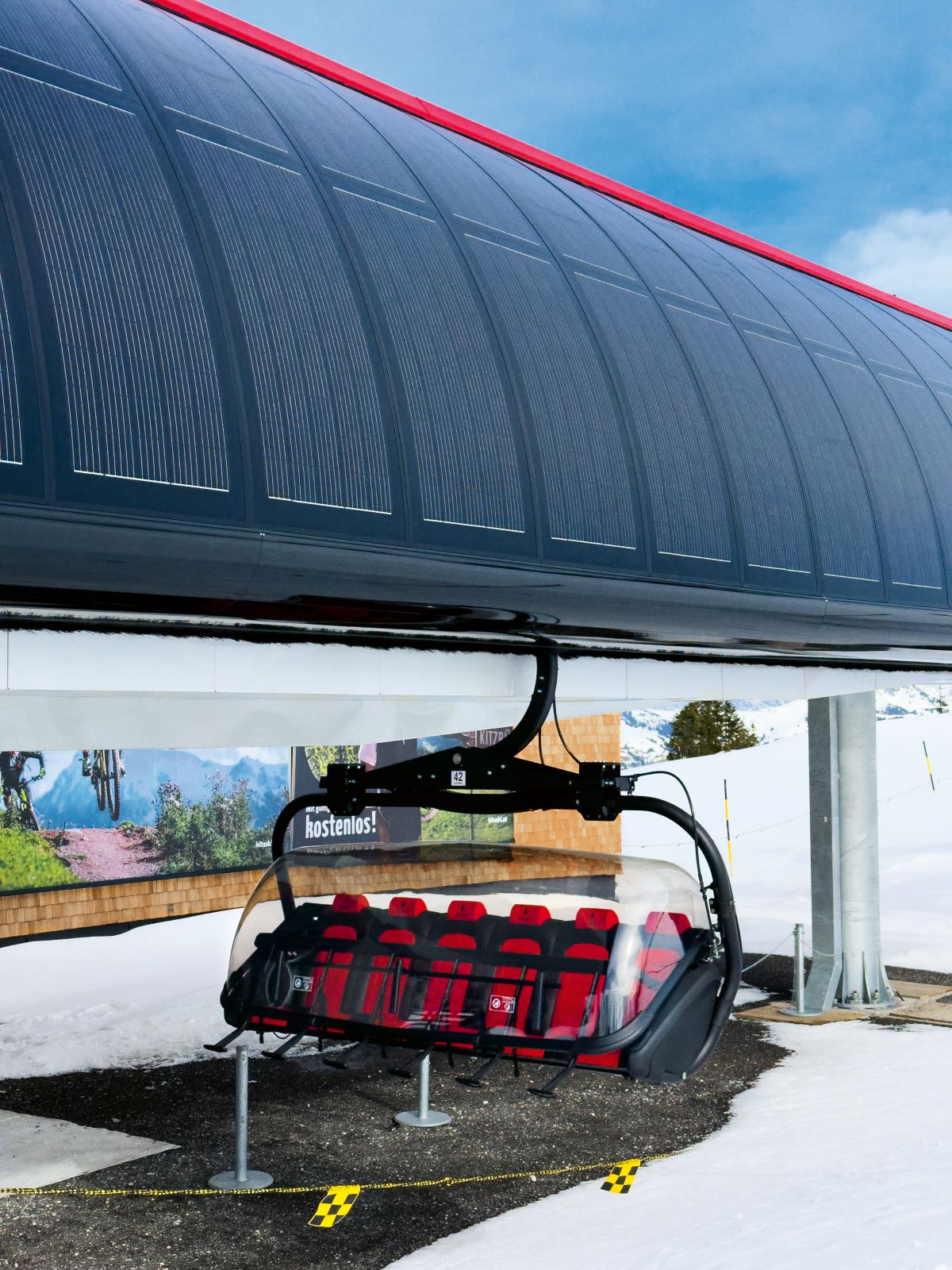
Whether urban or alpine, it makes no difference:
Solar modules are used not only in urban settings but also in alpine ropeway systems, as seen here at the Gauxjoch chairlift in the KitzSki ski area, Austria.
No difference between alpine and urban
According to Kirchmair, there is a clear demand for renewable energy among operators, and DOPPELMAYR has already implemented many projects characterized by an innovative overall energy system.
Examples include the Sierre–Montana Gare funicular in Switzerland or the Pico del Teide aerial tramway in Spain, which are equipped with a high-performance energy storage system (ESFOR) that stores locally generated energy – such as braking energy or photovoltaic electricity – and makes it usable.
In the alpine region, there are also cable car installations, such as the Hüttenkopf chairlift, the Glockner chairlift, or the Waidoffen chairlift, where solar panels are directly integrated into the station buildings – a solution that is convincing both aesthetically and functionally.
Significant energy-saving potential also exists in daily operations. With the ASC system (Adaptive Speed Control), it is possible, using AI, to adjust the operating speed of gondola and chairlifts according to demand, which directly saves energy.
Kirchmair emphasizes: There is no distinction between urban and alpine applications. What matters is whether the respective solution makes sense in the specific case.
PV on the roof
At the Waidoffen chairlift in Austria, solar panels are integrated directly into the station buildings—a solution that is both aesthetically and functionally convincing
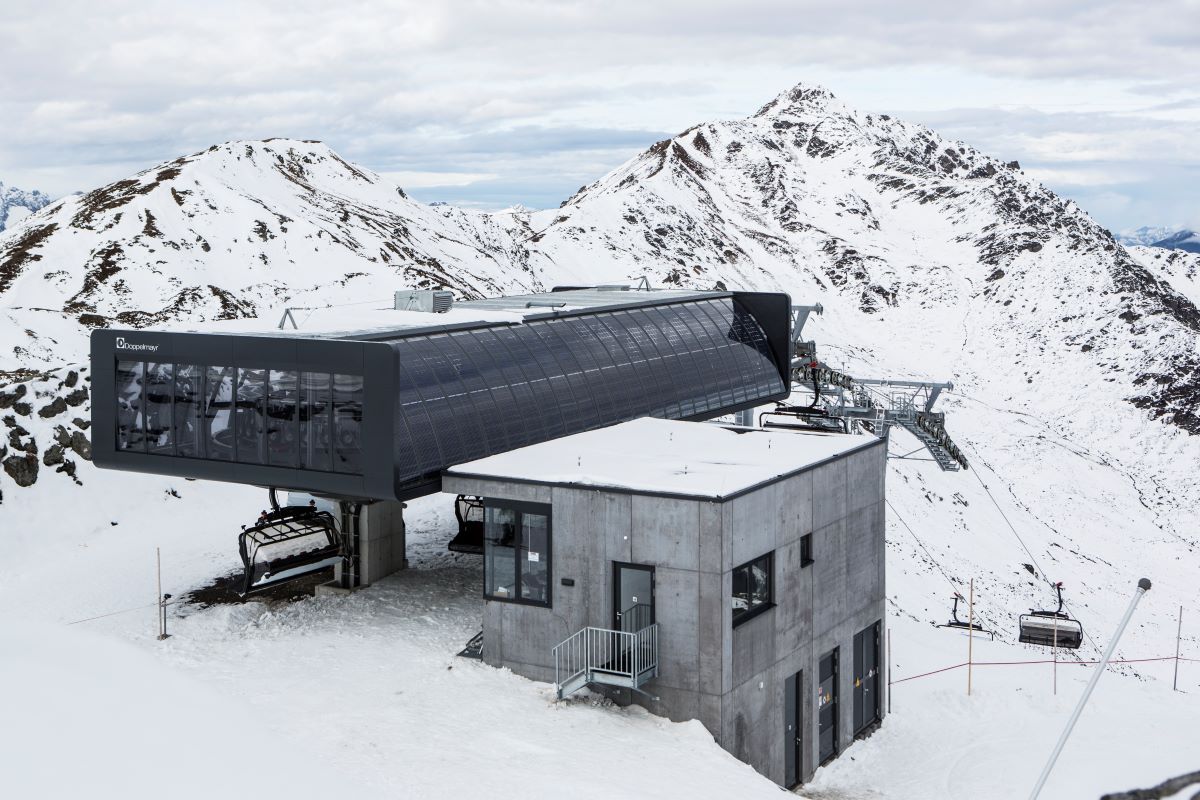
Solar panels not only on stations and cabins
Experts emphasize that in generating electricity with solar panels, not only cable car stations or cabins are suitable.
“The solution with solar panels on cabins has been in use for a long time and was developed in the Alpine region – but other surfaces can also be utilized,” explains Günter Tschinkel, Technical Director Electrical Engineering at LEITNER.
“Whether the surfaces of cable car stations are used depends on many factors, such as orientation, shading, and so on. It is also possible to use surfaces on storage buildings or other structures near the cable car or in the ski area,” adds Tschinkel.
“Electricity doesn’t have a label. This means that it does not matter where renewable electricity is generated, as long as it is consumed by a cable car. Therefore, there is no need to develop a special ‘self-generation model,’ but rather to find suitable locations for sustainable energy sources to supply the cable cars,” concludes Günter Tschinkel.
More independent of the energy market:
The cable car cabins of Mi Teleférico are already equipped with solar modules which, according to the operator, generate enough energy to power the lighting, intercom systems, and security cameras.
Energy-efficient consumption as an important factor
In addition to electricity generation and storage, manufacturers recommend paying attention to technologies that enable more efficient energy use, reduce waste, and optimize overall system performance.
For example, the Austrian ski resort KitzSki, together with LEITNER, is implementing various energy-saving solutions: as part of the renewal of the aging Gauxjoch and Trattenbach ski lifts, two modern 6-person chairlifts are being installed.
Solar panels are also being used: the stations are covered with a photovoltaic system, with curved PV panels replacing the previous polycarbonate sheets.
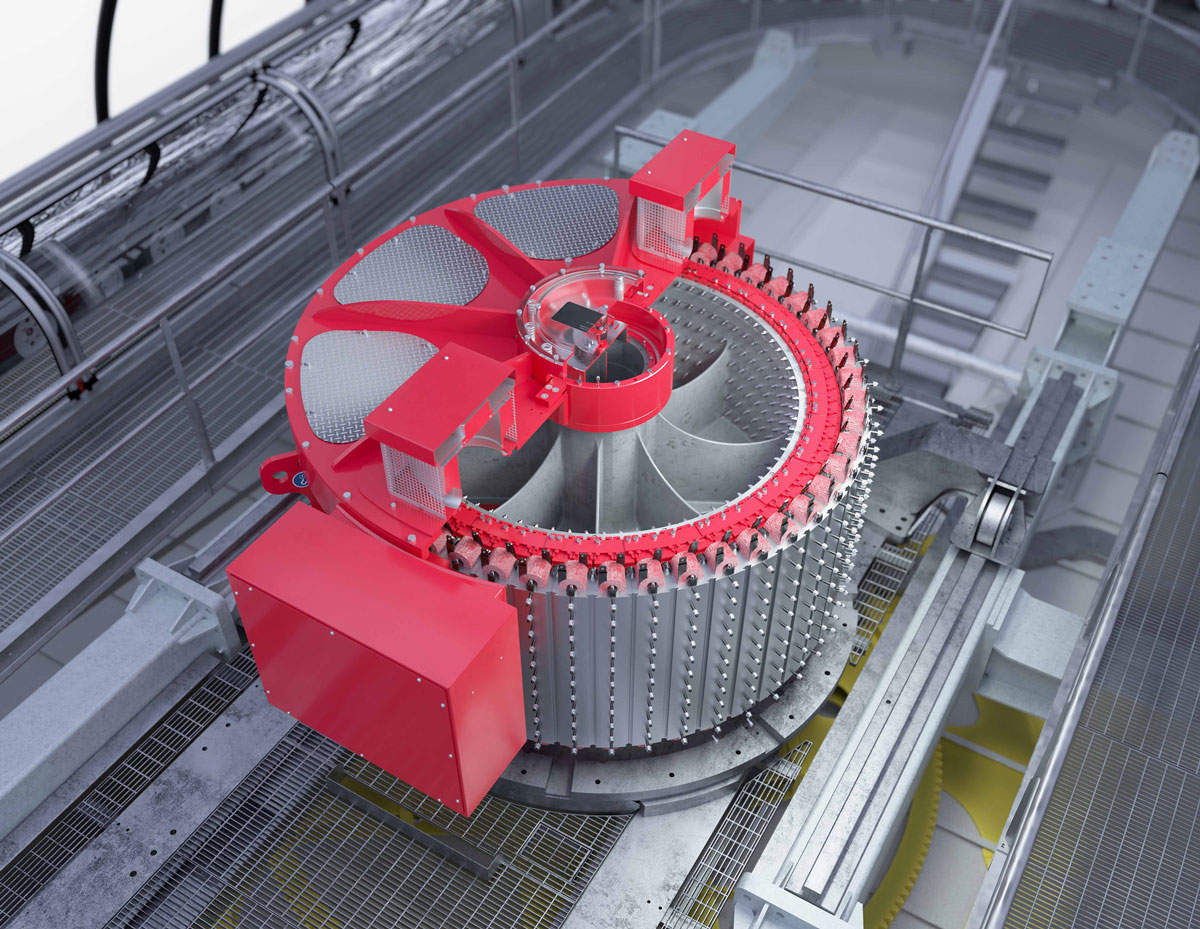
No more gearbox:
The LEITNER DirectDrive enables energy savings of up to twelve percent compared to conventional drive systems.
Other technologies – beyond PV
Soll ich noch den letzten Teil über den Lebenszyklus (Life Cycle) bearbeiten oder diesen Textabschnitt in einen anderen Kontext setzen?
Other technologies are also important: the LEITNER DirectDrive allows energy savings of up to twelve percent compared to conventional drives.
Furthermore, waste heat from the liquid cooling system is used for the heating system and hot water production. Up to 20 percent of energy can be saved through an automatically adaptive speed control for cable cars, which is integrated into the control systems of both installations.
The technology adjusts the operating speed based on a camera system that counts the number of waiting guests at the stations. The Intelligent Heat Detector system is also used: using a heat sensor on a reference vehicle and the access gates, the seat heating can be automatically regulated, contributing to energy savings.
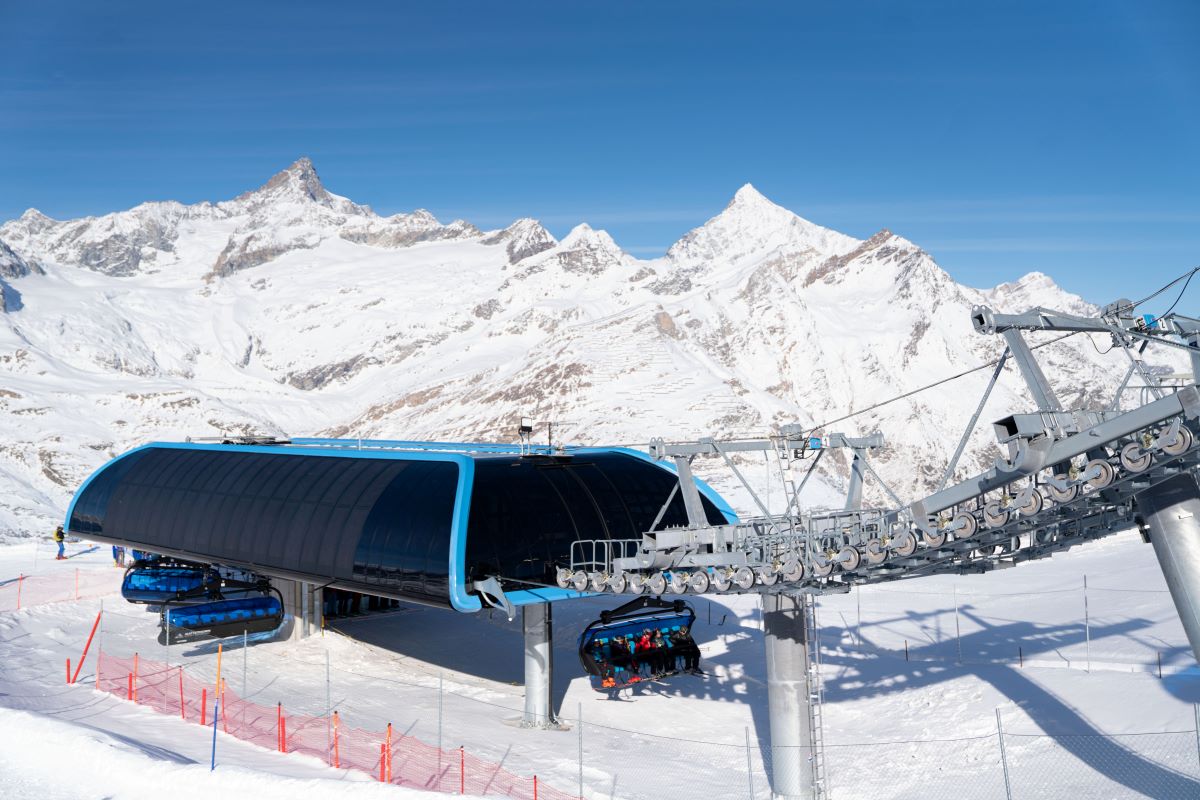
Pioneer on the mountain:
The Gifthittli chairlift in Zermatt, Switzerland, is equipped with solar modules.
Consideration of the entire lifecycle
According to Kirchmair from DOPPELMAYR, it is crucial when planning energy production and consumption to consider the entire lifecycle of an installation, from its initial design and construction to daily operation, maintenance, and eventual decommissioning or modernization.
- Planning and Implementation: It begins with a vision to realize the optimal solution, one that is convincing both ecologically and economically.
- Operation: Data management and continuous analysis form the basis for turning acquired insights into concrete improvements.
- End of Lifecycle: At the end of each installation’s life, a new beginning starts: components are repaired, materials are reused, or fed into the recycling cycle. This also applies to the modernization of installations or their upgrade to the latest technology – including the use of renewable energy.