Digitalisation & Innovation
AI in Guest Communication: Three Examples from Tourism
52 percent of German guests use Artificial Intelligence (AI) when traveling – or at least plan to use it in the future. Among AI users, around 50 percent were satisfied with the results.
This is shown by the current German Travel Analysis – an annual, nationwide survey by the Austrian National Tourist Office that examines the vacation travel behavior of the German-speaking population aged 14 and older.
Companies are therefore trying to keep up with the trend to improve the guest experience and simultaneously streamline their own work processes. SI presents three examples of how AI is being successfully used in tourism destinations today.

Teresa Karan
Head of the “Technical Systems and Channel Development” department at the Austrian National Tourist Office:
“As a next step, we are working on integrating further structured data, such as points of interest, accommodations, and restaurants. This will allow recommendations to align even better with individual preferences in the future. At the same time, we are experimenting with new functions – such as more highly personalized responses as well as supplementary AI applications—for example, for specialized chat assistants or to support marketing and content production.”
The “AI Concierge”: AI for travel inspiration…
The “AI Concierge” is a project by the Austrian National Tourist Office and is available to guests on the website austria.info. It helps them navigate the wide range of information available and gain a first impression of regions and offers.
In doing so, the concierge draws not only on content from the Austrian National Tourist Office, but also on information from the provincial tourism organizations – ensuring the answers are particularly local and up to date.
“With the ‘AI Concierge,’ we rely on a combination of search technology and generative AI. The concierge finds suitable information and, based on that, formulates answers to guests’ questions in real time,” reports Teresa Karan, Head of the “Technical Systems and Channel Development” department at the Austrian National Tourist Office.
At the start of the project, there were some typical teething troubles. Initially, the assistant formulated very long and flowery responses, which is why the system prompting and tonality were refined to achieve clear, compact results.
The use of the chat also made outdated content on the website visible, triggering a comprehensive update. Additionally, developers had to adjust the system to the fact that many guests ask very complex questions in complete sentences.
…and for a better understanding of guests
AI provides exciting insights not only to guests but also to the Austrian National Tourist Office itself—for example, regarding which topics lead visitors to the website.
A clear pattern shows the interest in Austrian cuisine: recipes and content related to culinary arts are among the most frequently used entry points on austria.info.
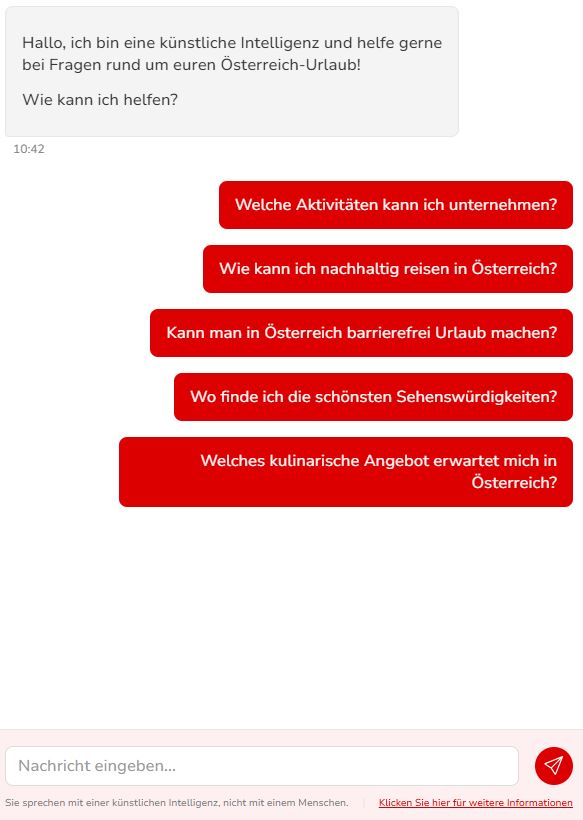
Translation: AI-Chatbot on website austria.info
What activities can I do?
How can I travel sustainably in Austria?
Is it possible to go on an accessible holiday in Austria?
Where can I find the most beautiful sights?
What culinary offerings can I expect in Austria?
Enter message
You are communicating with an artificial intelligence, not a human. Click here for more information.
“Within the chat itself, questions are predominantly fact-based and focused on specific travel recommendations, such as regions, activities, or travel periods. Culinary arts thus pique curiosity, and the ‘AI Concierge’ translates this curiosity into concrete travel ideas,” explains Teresa Karan.
The Austrian National Tourist Office also tracks the languages in which inquiries are made. German and English dominate here, followed by Italian, French, Japanese, Czech, Hungarian, Chinese, and Dutch.
Salzwelten: AI processes emails
The customer service team at Salzwelten receives nearly 30,000 emails annually with a wide variety of content—from booking requests and cancellations to questions about opening hours, prices, or lost property.
Manually sorting, answering, and forwarding these emails to the correct departments was not only time-consuming in the long run but also prone to error.
Since May 2025, AI has been supporting employees in this task. Emails are automatically forwarded and analyzed using an AI module. The system recognizes details such as names, language, and the nature of the inquiry.
Based on this, the AI generates suggestions for appropriate reply emails—including the correct tone and information from the internal knowledge base. Depending on the type of inquiry, emails are answered automatically, forwarded to employees for review, or moved to an overview for manual processing.
“If the AI cannot provide a suitable or complete answer to an inquiry, an employee takes over the task. This ensures that every inquiry is answered correctly and reliably—regardless of whether the AI can handle the case or not,” explains Ramona Wohlfahrter, Head of Internal Sales at Salzwelten.
With the help of this system, Salzwelten can respond to emails much faster. Additionally, the AI extracts useful data—similar to the “AI Concierge” – including visit dates, number of people, inquiry type, location, language, country of origin, booking numbers, and much more.
This creates a database that provides the entire organization with new insights, for example, for offer optimization, seasonal planning, demand identification, or target group analysis.
Tirol: AI on the slopes
Tyrolean ski resorts rely on intelligent visitor management and increased safety on the slopes – supported by data and AI models. Since COVID-19, initial measures to display waiting times at lifts have been implemented.
There are various approaches: In Ischgl, waiting times for the feeder lifts are displayed in the app. In Serfaus-Fiss-Ladis, boards have been installed at the mountain stations showing current waiting times at key lifts, allowing skiers to plan their descents accordingly.
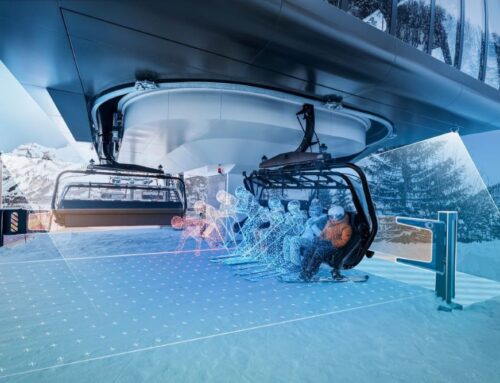
In this process, camera systems analyze the number of people at the lift entrances. Individuals are anonymized and evaluated only as a “dot.”
Primarily, ski resorts are aiming to further improve the guest experience. Winter sports enthusiasts are provided with information and can decide for themselves which slope or cable car to choose.
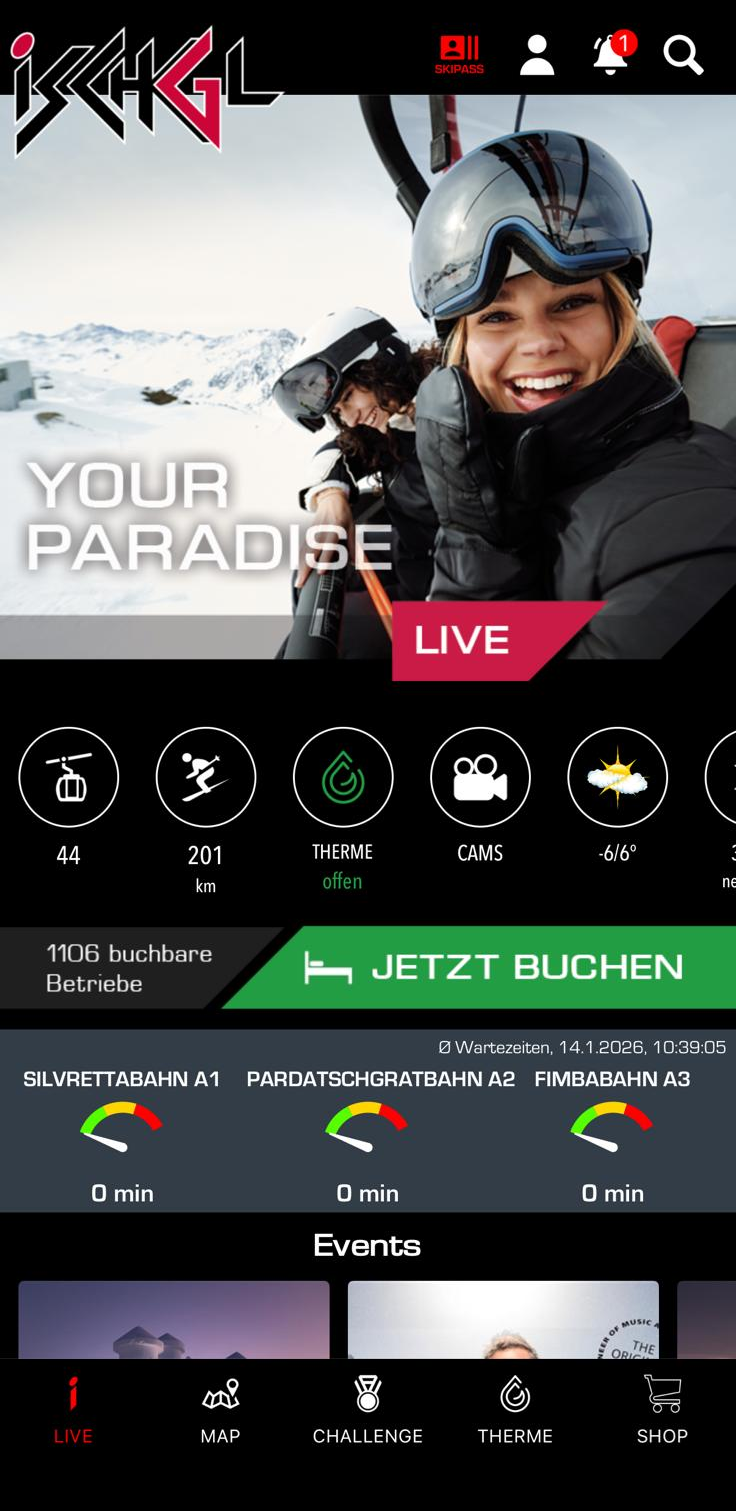
Intelligent visitor management
Waiting times are displayed in the Ischgl app.
Tirol Werbung, as a representative of Tyrolean tourism, is considering further possible applications. For example, the occupancy of mountain huts and restaurants could be displayed via a traffic light system. This would let guests know in advance whether to head straight for a hut or prefer to use the slopes for another half hour.
The depiction of slope quality is also conceivable: Is a run perfectly groomed, or have moguls already formed on the valley descent? Those already using AI agree: the potential is enormous – and even now, it significantly eases daily operations.
Whether in guest communication, processing emails, or visitor management: AI provides valuable insights and makes the vacation experience even more pleasant for guests.