Cities
Cable Car as a Booster
How can urban cable cars strengthen economies and societies? Cultural geographer and economist Clemens Schneider explored this question for the Friedrich-Alexander University Erlangen–Nürnberg.
Socio-economic foundation
According to Clemens Schneider, urban cable cars are economically and socially successful when they meet certain basic socio-economic prerequisites. One of these is physical barriers: overcoming obstacles (e.g., mountains, rivers, tracks, roads, buildings) with ease is one of the greatest strengths of urban cable cars.
The decision in favor of a cable car is made more easily when such a requirement exists. “Urban cable cars are also possible in flat terrain. Their potential has not yet been fully exhausted,“ Schneider emphasizes. Nevertheless, cable cars are receiving increasing political attention as a means of public transport

Clemens Schneider,
Content Operations at Helpbnk, formely Uni of Erlangen-Nürnberg.
Poor accessibility actually leads to socio-economic disadvantages. People living in remote neighborhoods have to spend more time and money on mobility. “Under the geographical concept of accessibility, cable cars already contribute to the equality of living conditions in the Global South,“ Schneider reports.
People without private cars, in particular, benefit from such connections. Evidence for this can be found in Bolivia and Colombia, among other places.
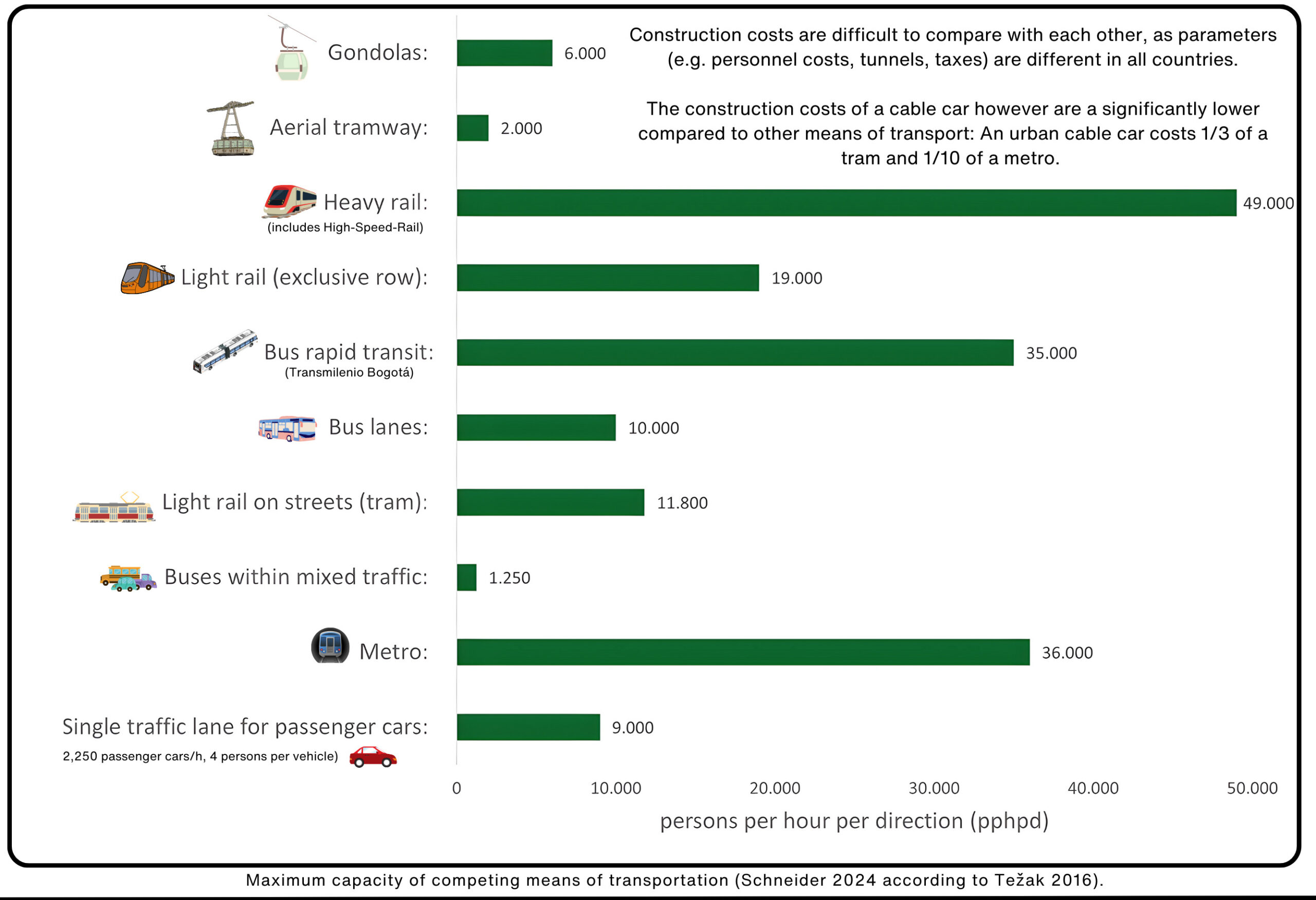
The capacity and cost analysis of various forms of mobility can also speak in favor of the cable car: for example, while gondola lifts with a maximum of 6,000 people per hour and direction are significantly less powerful than mass transit systems, they are also significantly cheaper, says Schneider:
“Construction costs are difficult to compare because parameters – such as personnel costs, tunnels, or taxes – differ from country to country. In general, however, it can be said: a cable car costs only 1/3 of a tram and 1/10 of a subway.“
Analysis
Analysis of capacities and investment costs of various modes of transport.
Tools for Success
For urban cable cars to become truly successful on this basis, Schneider says instruments of regional transport development are required. The cultural geographer cites three examples.
Legal-financial interventions:
Legal-financial interventions, such as a workplace parking levy to reduce traffic congestion and promote public transport.
“It works through a fee per vehicle parked at the workplace. In the case of the English city of Nottingham, companies with eleven or more parking spaces pay £650 per additional space per year – as of 2024,“ explains Clemens Schneider.
This measure generates high revenues that are reinvested in public transport, representing a major opportunity for financing cable cars.
Integrated urban development:
Integrated urban development projects:
According to Schneider, Transit-Oriented Development aims to create compact, mixed-use neighborhoods around public transport hubs. This integrated approach promotes sustainable urban development through dense, pedestrian-friendly neighborhoods with good connections to public transport.
“Another field of application for cable cars is mixed-use development. Developing the immediate surroundings of cable car stations holds great potential,“ says Schneider.
An intermodal transport strategy:
An intermodal transport strategy, which includes the seamless linking of different modes of transport. As part of such a strategy, cable cars can help make commutes more efficient, sustainable, and stress-free.
Cable car as a social boost
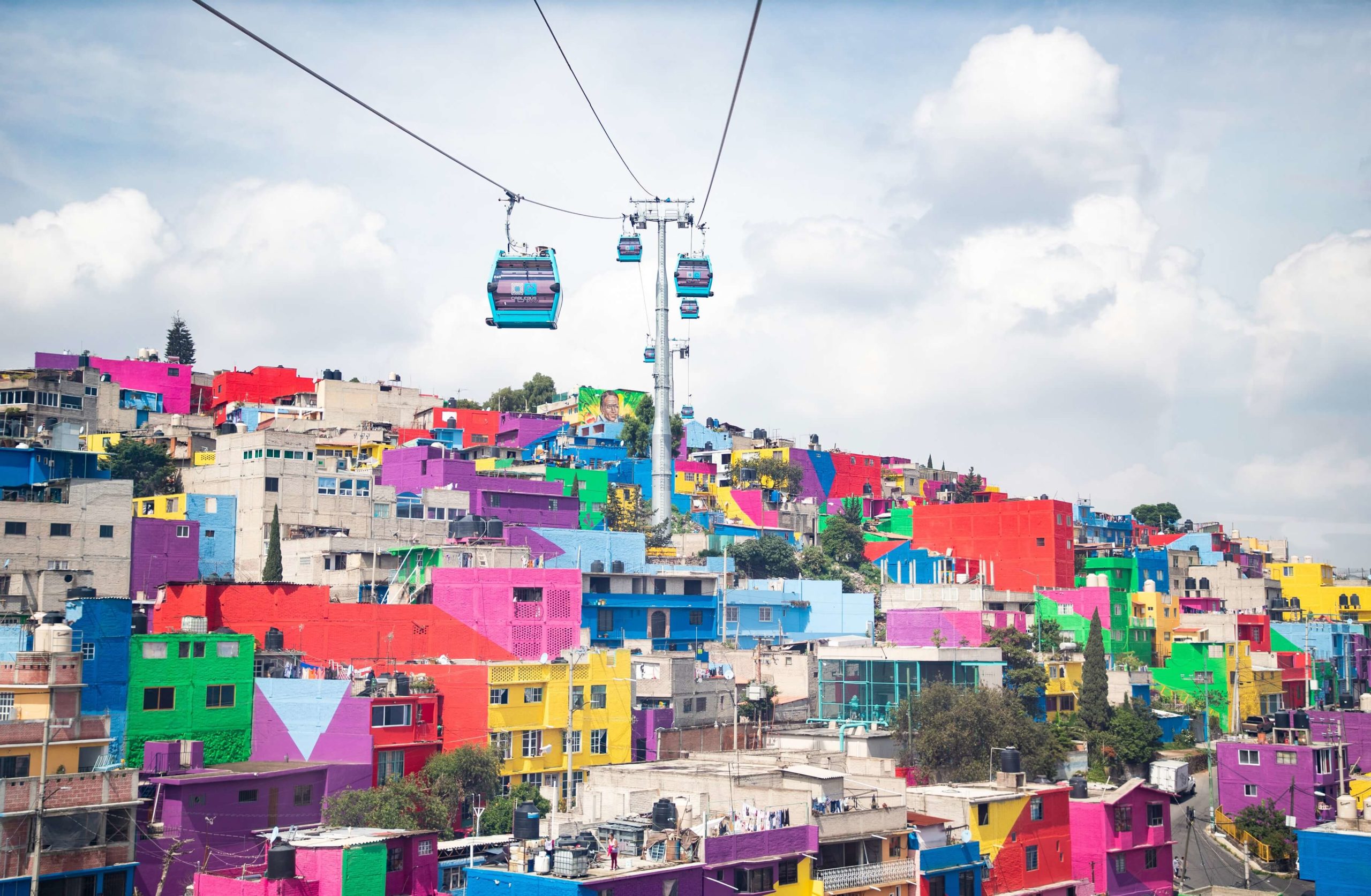
The houses surrounding the Cablebús 2 in Mexico City were painted in vibrant colors.
Three types of effects
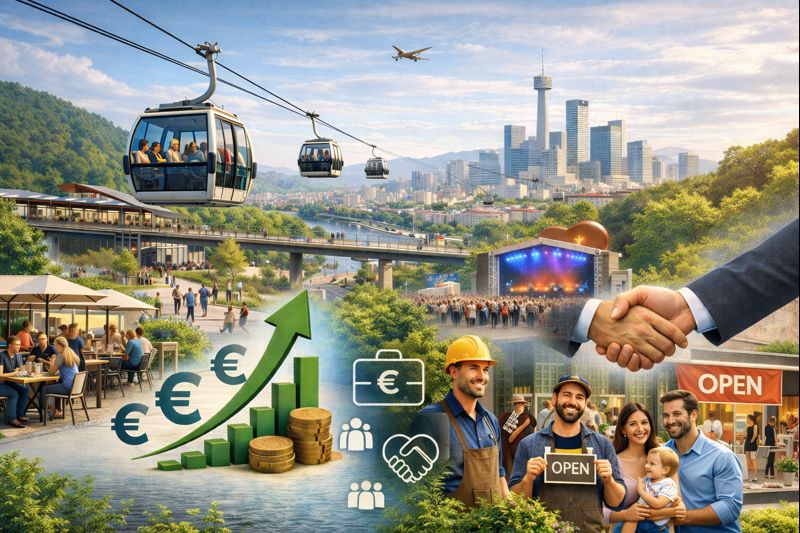
Through these instruments, urban cable cars trigger direct, indirect, and induced effects, according to the cultural geographer.
Direct effect:
Direct effect: Improved accessibility. “Time savings on routes open up new opportunities for work and daily life. Experience from Colombia shows a reduction in travel times to central business districts as well as affordable mobility,“ Schneider explains. Improved accessibility is the basis for all social and economic effects.
Indirect effect:
Indirect effect: The increased attractiveness of the neighborhoods through which the cable car passes. Fast connections to the city center attract new residents, property values rise, and gentrification may occur, Schneider reports. A cable car can also attract new companies and thus jobs to the area.
Furthermore, cable car stations can serve as social meeting points – with car-free, green, walkable areas – having positive effects on the quality of life in times of climate change. Better accessibility also leads to more opportunities in education and professional life.
Induced effects:
These can be observed at the level of every resident, according to Schneider: “In the Global South, better accessibility to the city center ensures better-paid jobs, while in the Global North, cable cars can upgrade suburbs.“ Local public institutions near cable car stations – such as libraries, schools, and universities – could reduce social exclusion and increase educational levels.
“Last but not least, cable cars upgrade the neighborhood and the quality of life for residents, for example through shorter commute times, better air quality, and safe, quiet transport,“ Schneider concludes.