


Cities
Innsbruck: Residents See Potential in Urban Cable Car
Travel by cable car from Innsbruck’s main railway station to the Patscherkofel valley station in around 18 minutes. Studies commissioned by the Province of Tyrol, Austria, indicate that such an urban cable car would be technically feasible in principle and could offer potential as a complement to the existing public transport network.
Following an initial feasibility study, the Province commissioned a further in-depth assessment. The results are now available.
Strong public support
A survey of around 3,700 people in Innsbruck and the eastern Mittelgebirge region shows that the idea has attracted considerable interest.
- 72 per cent of respondents in the eastern Mittelgebirge consider the proposed cable car connection a worthwhile idea.
- In Innsbruck, the figure stands at 67 per cent.
- Around four per cent say they would use the cable car daily, while approximately ten per cent could see themselves using it several times a week. A further 24 per cent would use the connection at least several times a month.
- This means that more than a third of respondents would use the cable car regularly.
Respondents were particularly positive about the expected level of travel comfort, safety and punctuality. Environmental benefits and independence from road traffic were also among the most frequently cited advantages.
Opinions were more divided when it came to land use and the impact on the landscape. Respondents also identified susceptibility to wind as a potential disadvantage.
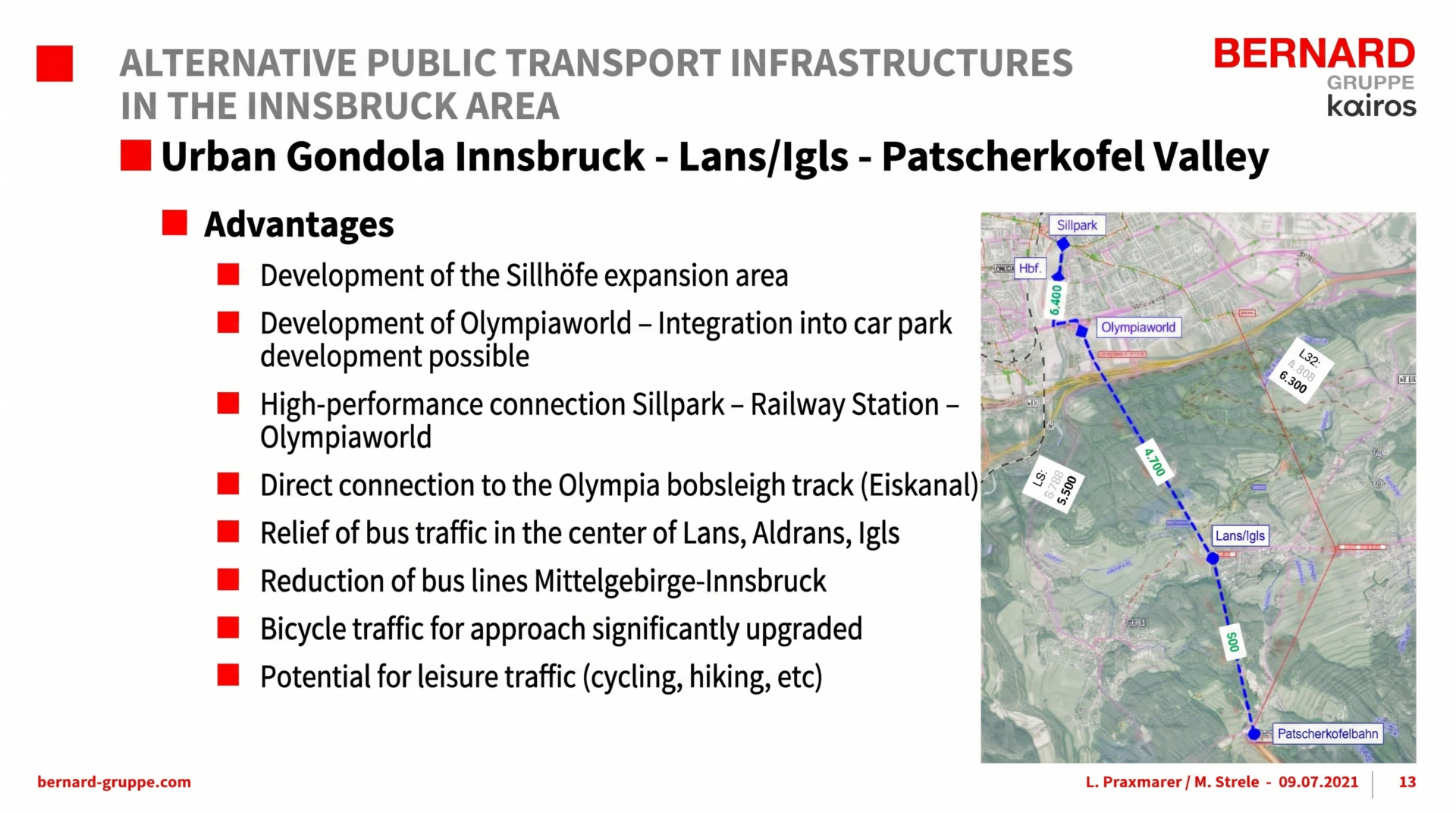
Alternative Public Transport Infrastructure in the Innsbruck Region.
The slide is taken from the presentation of the 2021 feasibility study.
Cable Car Could Help Reduce Road Traffic
The results of the in-depth data analysis and feasibility assessment indicate a modelled potential of around 5,200 cable car journeys per average working day (excluding tourist traffic).
Such a connection could also help ease traffic on the roads in the eastern Mittelgebirge region.
According to the calculations, the cable car could potentially reduce car journeys by a total of 4,700 per day. This would represent a decrease of around 35 per cent, with the L32 Aldranser Straße expected to benefit in particular.
Costs and Implementation Details Still Unclear
With the two studies, the Province of Tyrol has established an initial data basis for the project. However, this does not constitute a decision to proceed with construction. Questions regarding connections to the network, the exact design and costs have not yet been conclusively examined.

René Zumtobel
Provincial Councillor in Tyrol, Austria
“The findings provide a transparent basis for deciding whether the idea should be pursued further. If we want to manage traffic effectively, we must remain open to all ideas and possibilities. We have examined what would be feasible in principle and how the public feels about the proposal. It is now up to the municipalities to assess the survey results and use the findings to decide whether they wish to take further steps.” © Province of Tyrol
The project requires further detailed analysis. This includes assessing its susceptibility to wind, selecting a suitable cable car system – such as a City Cable Car solution or a three-cable (3S) gondola system – and coordinating the service with the existing bus and rail network.
Any reorganisation of bus services and connections to the surrounding municipalities would also need to be taken into account. Given the current stage of the project, it is therefore not yet possible to provide a reliable cost estimate.


