
Management & Tourism, Snowmaking & Slope Maintenance
No Japow: Is Japan losing its powder snow?
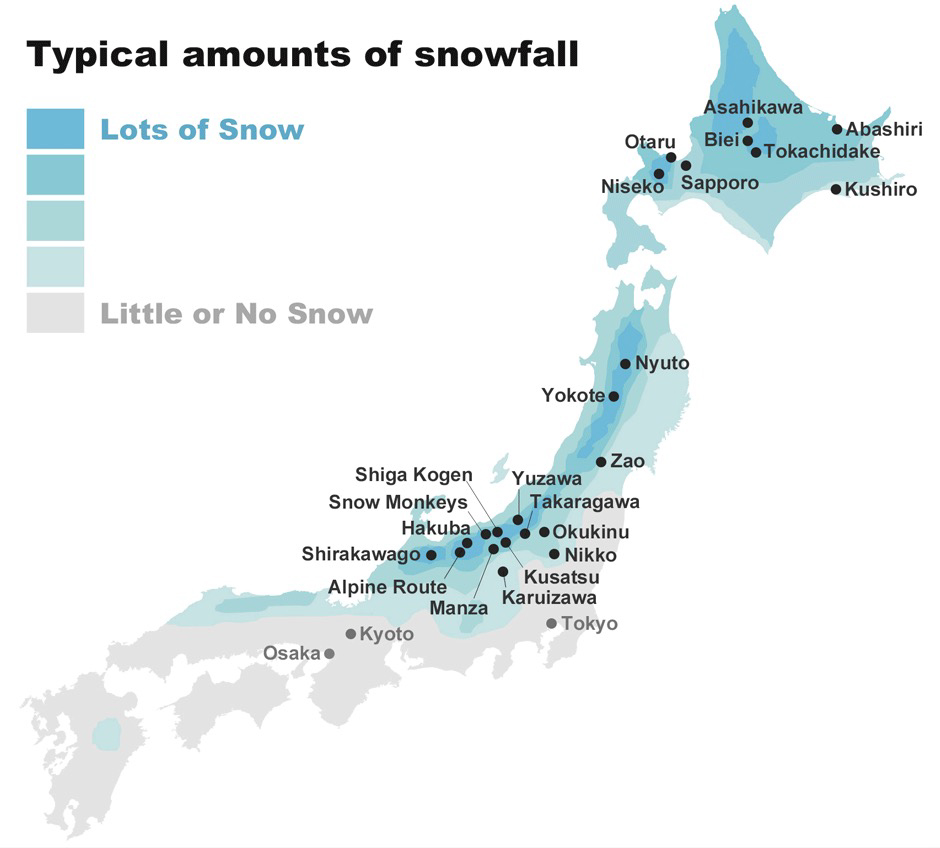
Many Japanese ski resorts advertise their snow conditions to foreign tourists. Japan’s powder snow, known as “Japow”, is a crucial part of winter tourism in regions such as Hokkaido and Nagano.
A study by Hokkaido University and the Forestry and Forest Products Research Institute now warns of drastic consequences of climate change for Japanese winter sports, as reported by the news portal Sumikai.
The reason for this is the projected decline in natural snow:
Scenarios
- 4-degree scenario (without effective climate protection): Of the 349 ski resorts currently examined in Japan, only seven could still operate entirely on natural snow. A further 26 areas could at least keep parts of their slopes open.
- 2-degree scenario (Paris Agreement target): Even with more moderate warming, only 53 ski resorts would remain fully usable and 108 partially usable – mainly high-altitude or northernmost areas.
- Fewer snow days: While many regions previously recorded more than 20 snow days per year, projections show this number dropping to 12–16 days under 2-degree warming and under 10 days under 4-degree warming.
Economic Significance of Powder Snow
“Japow”, Japan’s famous powder snow, is a key economic factor. International winter sports guests stay in the country significantly longer on average (nearly 14 days), spend roughly 40% more money than regular tourists, and predominantly travel (over 93%) to rural regions outside the major metropolitan areas. A lack of snow therefore directly threatens the regional economy.
Adaptation Strategies and Government Responses
In light of the foreseeable warming, scientists and the Japan Tourism Agency advise adaptation:
-
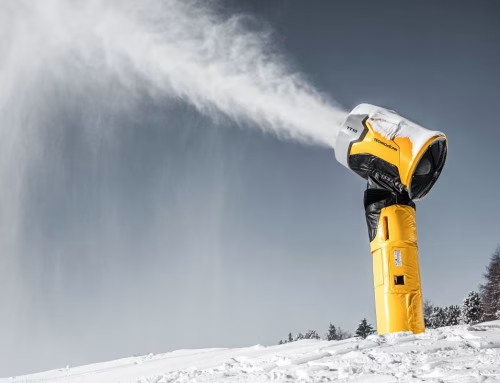
Technical upgrades: An increasing number of ski resorts are applying for government subsidies to purchase snowmaking equipment and modern lifts (a large portion of the existing lift infrastructure is outdated and over 20 to 30 years old).
-
Year-round tourism: Authorities strongly recommend that winter sports destinations expand their offerings for spring, summer, and autumn. The goal is to transform into year-round mountain resorts to reduce dependency on short, snow-scarce winters.