Cities, Tourism
Urban Ready: Full Service for Ropeway Ropes
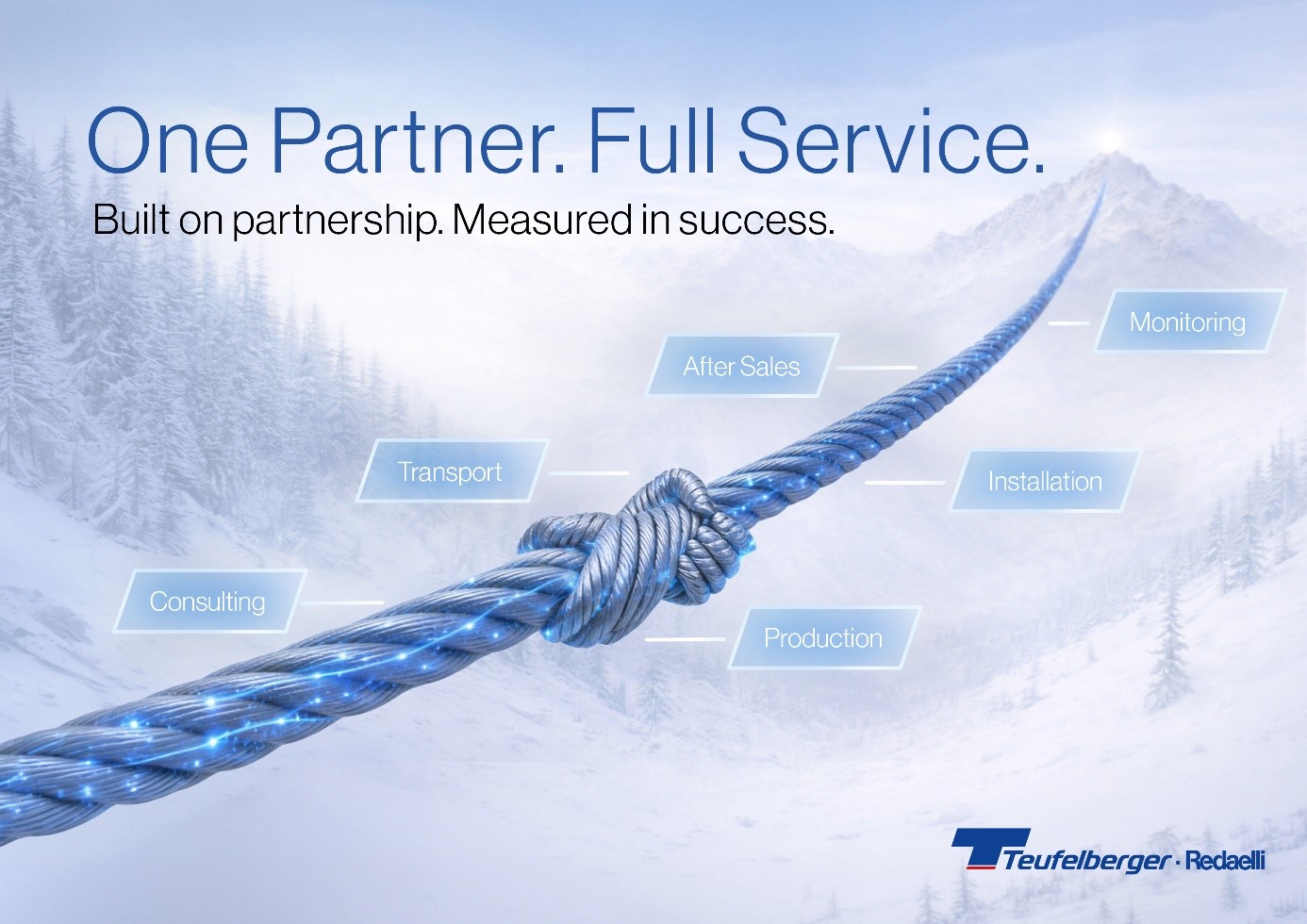
Teufelberger-Redaelli is increasingly positioning itself as a full-service provider in the urban ropeway industry. “We are more than just a supplier – we are a reliable service partner for our customers,“ emphasizes Johannes Smetana, Head of Business Unit Cableways.
In concrete terms, this means: a single point of contact for ropeway projects instead of numerous interfaces, clear responsibilities, high planning reliability, efficient execution, and simple coordination – throughout the entire service life of a rope.
Solitec® XD Urban Ropeway Rope
The full-service approach begins with the Solitec XD® urban ropeway rope. Featuring an extended service life based on state-of-the-art rope technology, it meets the demands of urban operations characterized by high operating hours and high system availability.
The Solitec® XD delivers significantly fewer wire breaks compared to standard round strand ropes at an identical number of bending cycles. Consequently, its application is particularly advantageous under demanding conditions with long daily operating times, such as those found in urban ropeway systems.
Replacement investments are required only at a much later date. Furthermore, the rope offers numerous additional benefits, including exceptionally smooth running and low noise levels.
Solitec® XD is utilized in numerous installations worldwide, ranging from heavily used urban tourism people movers in Las Vegas to hightraffic alpine ropeways in Ischgl and Oberstdorf, as well as ropeway systems in Italy (Andalo, Canazei, Pordoi, and San Martino).
From project engineering to delivery and installation, Teufelberger-Redaelli handles all tasks surrounding the procurement of a new Solitec® XD rope.
ADVANTAGES: SOLITEC® XD
- Perfect for urban ropeways
- Extended service life
- Low noise and vibration for maximum ride comfort
- Optimized running properties for smooth and uniform transport
- Excellent stability of geometric parameters thanks to innovative rope construction
- Low elongation behavior
- Optimized for large dimensions and high speeds
Monitoring the Rope in Operation
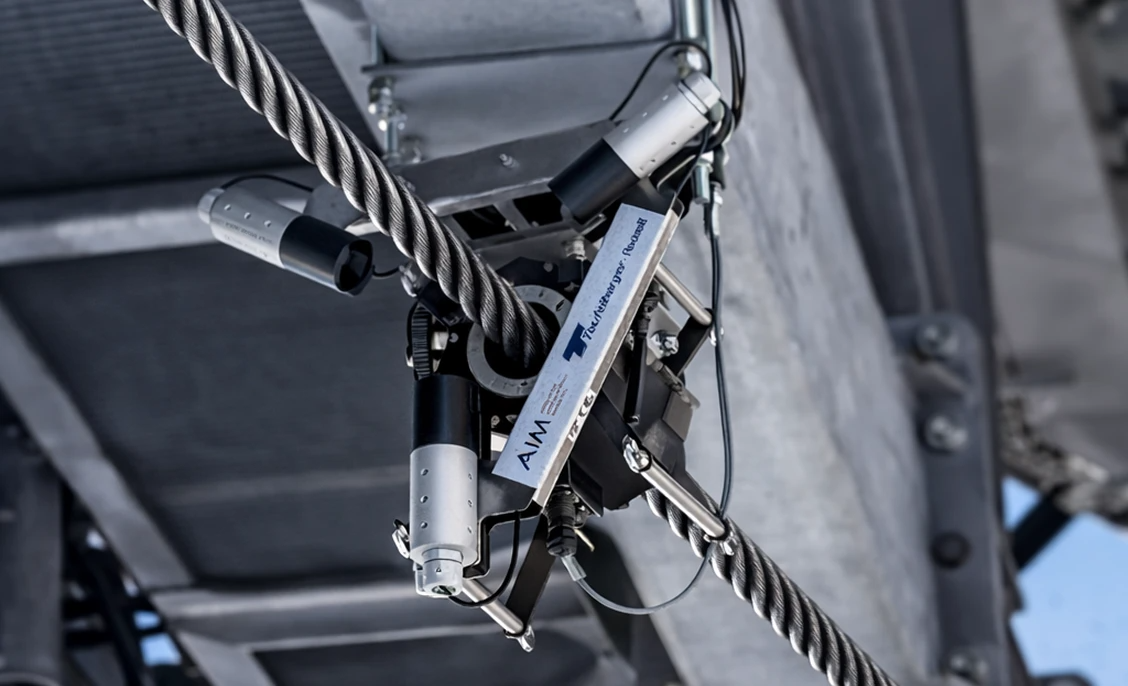
Teufelberger-Redaelli remains by the side of urban ropeway operators long after installation and commissioning. Launched on the market this year, the “AIM Tool“ monitors the rope in real time.
The device originated within the Alliance for Intelligent Rope Monitoring (AIM), which pools the expertise of AI software specialists from Raidyn and Magnetic Rope Testing (MRT) measurement experts.
This all-in-one system combines camera-based condition monitoring, Magnetic Rope Testing (MRT), and artificial intelligence (AI) to detect anomalies, defects, and corrosion on the rope at an early stage. Data is accessible in real time from any location. With the AIM Tool, the alliance partners open up completely new possibilities for combining MRT with camera-based condition monitoring.
In doing so, they increase system availability for operators, minimize downtime, and enable predictive maintenance.
Present:
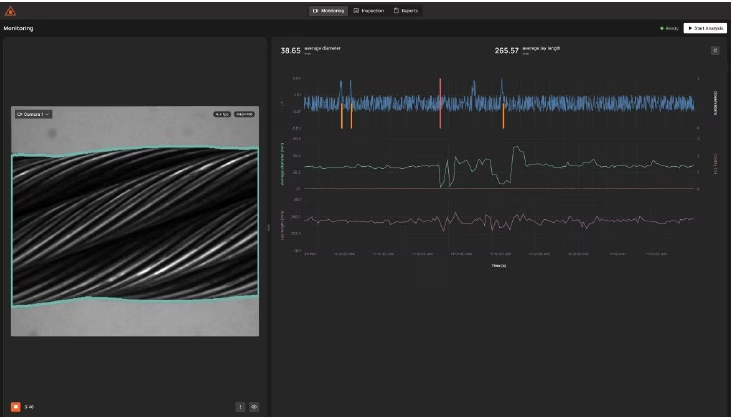
Real-time rope condition display of the AIM.
Uninterrupted Live OperationUninterrupted Live Operation
A look at practical application: For testing purposes, the AIM Tool was installed in Zermatt (Switzerland) on the Findeln detachable 4-seater chairlift operating at a speed of 5 m/s, directly connected to the operator‘s network.
Visual analysis and MRT work in tandem, while automated evaluation delivers concise information regarding the rope‘s condition. The system has now been running continuously for months.
The challenging ambient lighting conditions on site are compensated for by the cameras, which provide exceptionally high image quality. Synchronization with the MRT system runs seamlessly, and automated reporting already delivers concise summaries of rope health, reports Fabian Imboden, Head of Technical Department North at Zermatt Bergbahnen: “The system has the potential to save us a huge amount of time.“
Future:
Knowledge-based lifetime estimation.
Fast Installation in Zermatt
A key advantage lies in the practicality of the installation: the system was mounted during a short time frame – in the evening after closing hours and the following morning prior to reopening.
Furthermore, the camera system is physically integrated into the MRT unit, enabling a combined inspection process within a compact design. Operationally, the installation has proven to be extremely reliable – even when subjected to system vibrations.
The camera‘s background processing operates robustly even with moving chairs, passengers, and other dynamic elements in the field of view. Simultaneously, the AI model precisely isolates the rope and identifies critical points such as splices.
This pleases Fabian Imboden in particular: “Now we can comfortably monitor the rope condition right from the office.“
Today, the tool recognizes the current condition of the rope. Tomorrow, historical inspection data and continuously collected information are set to increasingly help better assess rope condition trends and remaining service life. “As a result, our role is shifting: from inspecting a rope to understanding its entire lifecycle,“ emphasizes Smetana.
The Future of Rope Condition Assessment
The AIM Tool celebrated its market debut in spring at the Mountain Planet trade show in Grenoble (France). There, Tommaso Tamarozzi, CEO of the AI startup Raidyn, delivered a lecture on AI-driven monitoring and visual defect detection of ropeway ropes.
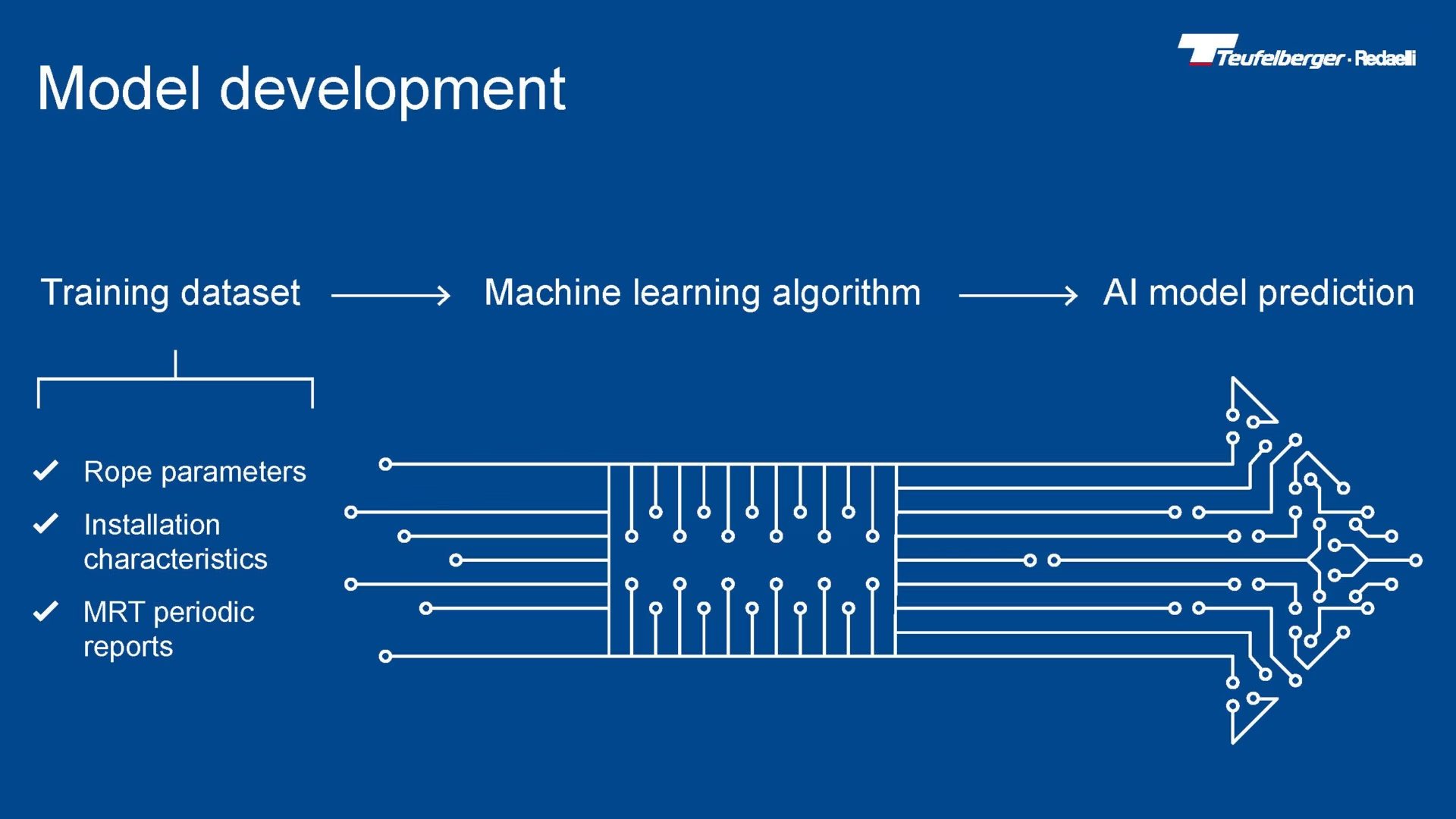
Viola Corsini, R&D specialist at Teufelberger-Redaelli, presented on AI predictions regarding ropeway rope longevity. Under the concept of “Knowledge-Based Lifetime Estimation (K-BLE),“ Corsini explained how rope parameters, system-specific details, and regular MRT reports generate a comprehensive dataset.
Based on this dataset, machine learning algorithms train to produce AI-driven service life predictions: “In the future, AIM and K-BLE will work together to calculate the remaining service life of a ropeway rope,“ reports Corsini.
This concept opens up a vast array of potential future developments. By continuously updating the model with fresh data, a regular exchange with end users (inspection institutions and ropeway operators) is established – leading to an increasingly representative model as well as stronger partnerships and collaborations.