Cities, Tourism
Bureaucracy on a Rope: Managing Contracts and Risks Digitally
Urban ropeways cross over or border numerous properties, employ a significant number of staff, are serviced by manufacturers as well as service providers, and rent buildings, infrastructure, and software. This results in a multitude of contracts and agreements – with rights, obligations, and payments.
To ensure operators do not lose track, Swiss company REMEC offers digital contract management. The module is embedded in the SAMBESI maintenance software, which includes a variety of tools for ropeway maintenance and management and is used by many ropeways, including urban systems in Haifa, Luxembourg, Hong Kong, Katoomba, Stoos, and Braunwald.
SAMBESI MODULS
- Dashboard
- Maintenance
- Events
- Logbook
- Risk Management
GIS - Contract Management
Cost Management
Administration
Spare Parts
Documents
Reports
Managing Contracts & Obligations
Specifically, SAMBESI offers structured storage for all contracts, providing operators with a unified overview of all obligations – both financial and in the form of physical or labor services.
The software displays the contracts associated with each partner, alongside the number and total cost of outstanding and fulfilled obligations.
The program handles recurring compensation correctly and automatically, adjusting it to the inflation index as needed. Other rights and obligations can also be managed with SAMBESI.
Screenshot:
Contract management in SAMBESI.
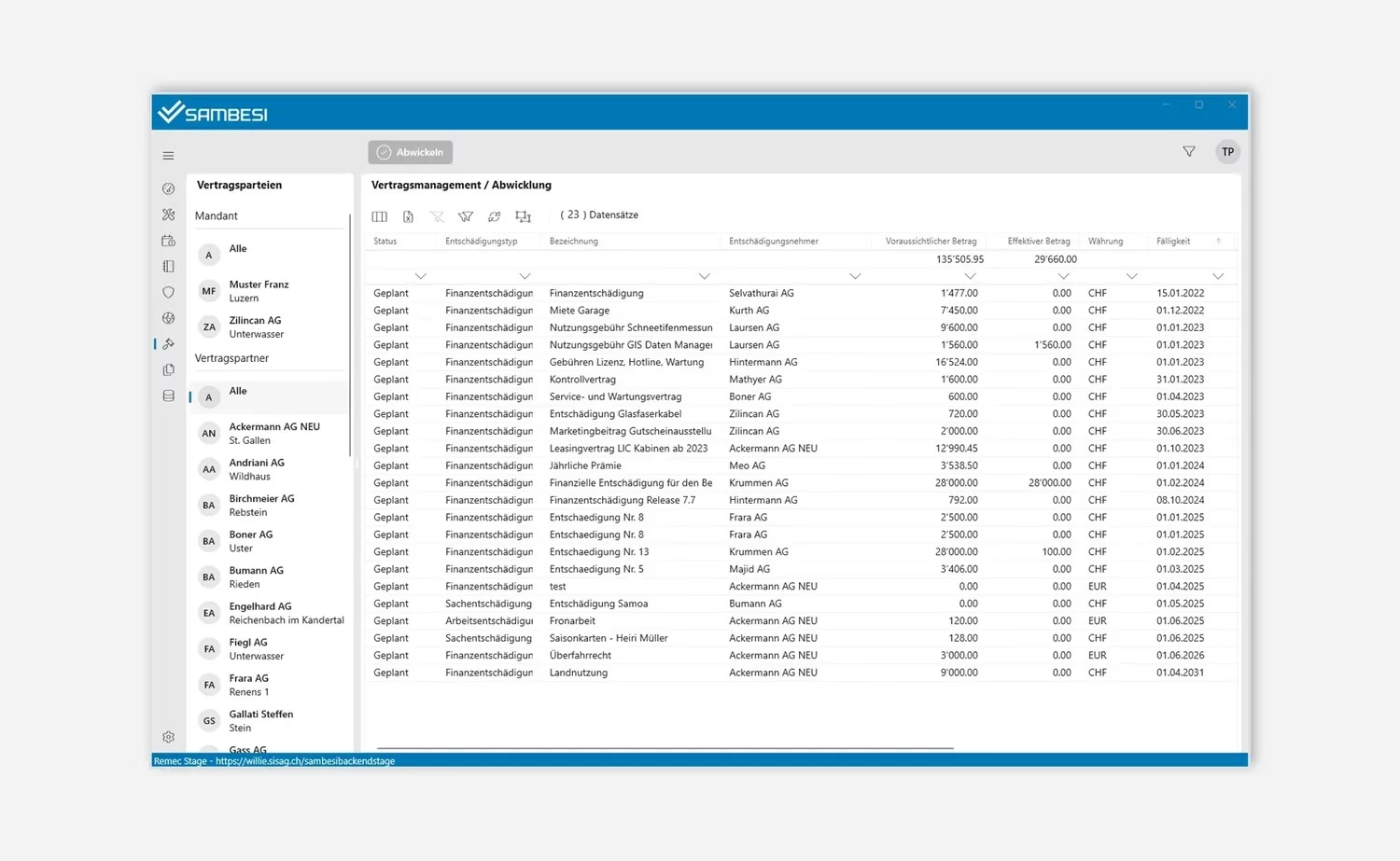
The system reminds users of deadlines, links to original documents, and assigns contracts to individual clients or assets – such as a ropeway tower to a specific landowner.
This creates a balance of knowledge that, with many contracts, would otherwise tilt against the ropeway operator. Technical management, commercial directors, or supervisory bodies thus maintain a constant overview of all operating, labor, rental, maintenance, rightof-way, or even internet contracts, making agreements easier to clean up and adjust.
In this context, internal and external communication is also simplified: contract reports can easily be exported with custom branding and sent to contractual partners or accounting.
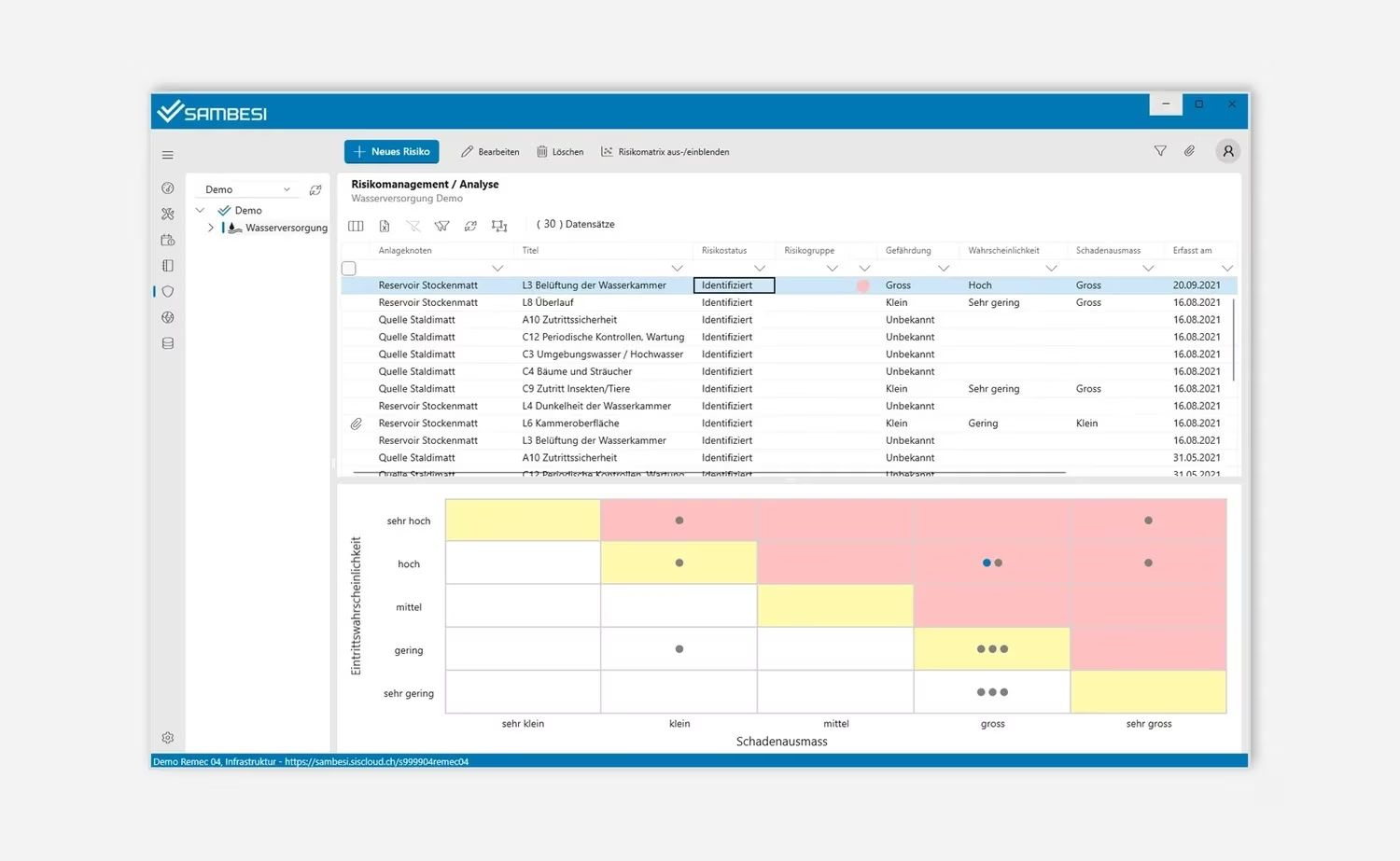
Screenshot:
risk management in SAMBESI.
Managing Risks, Weighing Plans
The SAMBESI software also encompasses risk management. With the corresponding module, ropeway operators can assess financial and technical risks and evaluate feasibility as early as the planning phase.
Assessments of line alignment, for instance regarding proximity building rights, are also possible. In principle, SAMBESI can capture all conceivable countermeasures across all organizations in advance, after which probabilities and consequences can be evaluated.
Risk management is also an important tool during operation and maintenance, where identifying, analyzing, and resolving problems takes place in a clearly structured three-step process. The non-OK status of maintenance steps is automatically imported from other modules into the risk management tool.
In addition, risks can optionally be linked to other modules, such as maintenance or contract management. As a result, employees automatically receive tasks directly from risk management, buyers are informed of spare part requirements, or the supervisory board can stay updated on the status of the ropeway system.